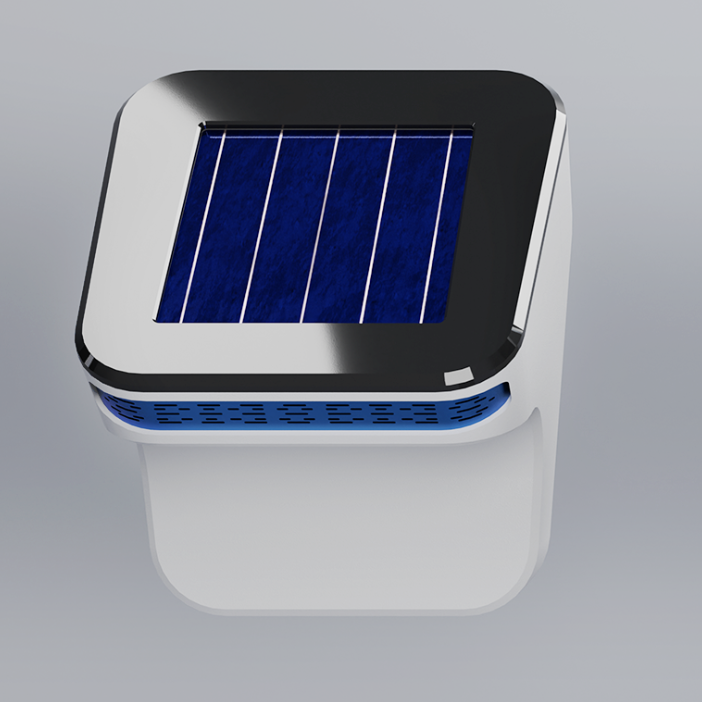
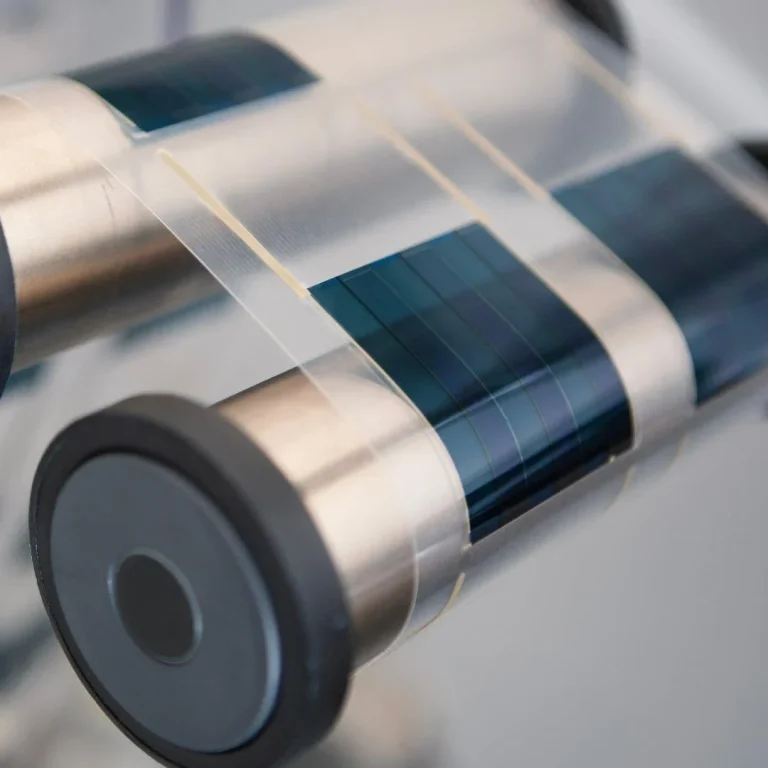
Developed by REEF IoT as part of the ATiP project at Swansea University, AIR-sense-IQ is a photovoltaic CO2 monitor that runs entirely on indoor light. Powered by Epishine's printed organic solar cells, the device required an enclosure that could house sensor, communication and power electronics within a form factor that maximises light capture — all without a single battery to replace or wire to run.
Design & Development
REEF IoT approached the project with a clear technical constraint: the device needed to be entirely self-powered, drawing energy from ambient indoor lighting via Epishine's flexible printed solar cells rather than mains power or replaceable batteries. This placed unusual demands on the enclosure from the outset — the solar panel's orientation and surface area were non-negotiable, and the internal layout had to work around the panel rather than the other way around.
The objective was to design a wall-mountable housing that positioned the solar collector for maximum light exposure in a typical office setting, while integrating a CO2 sensor, environmental sensor, GPS/comms module and power management board into a compact, unobtrusive footprint.
Industrial Design
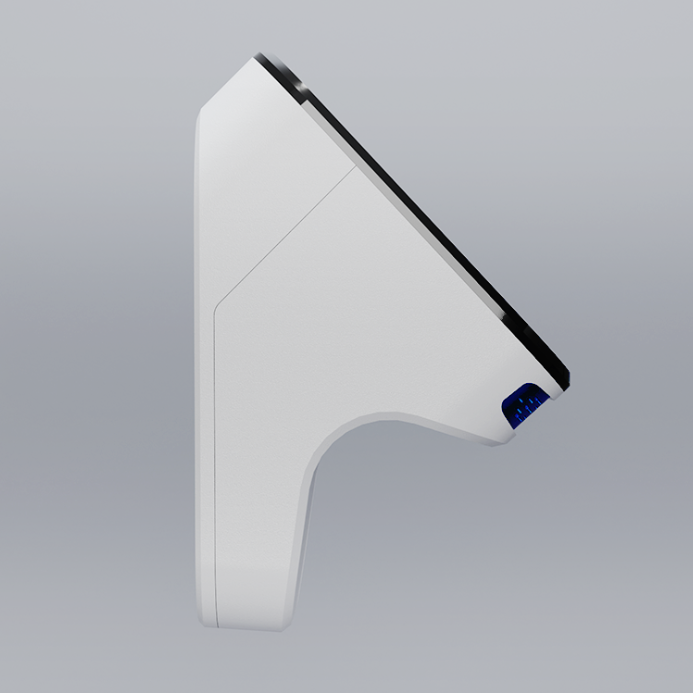
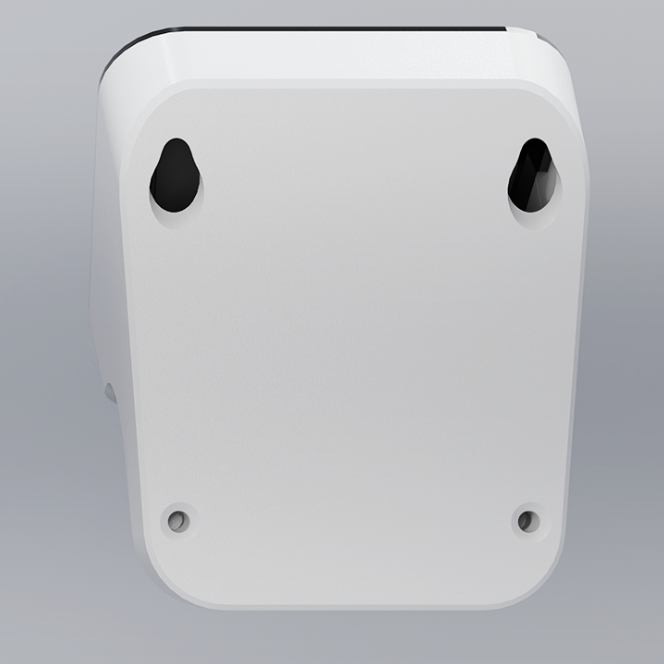
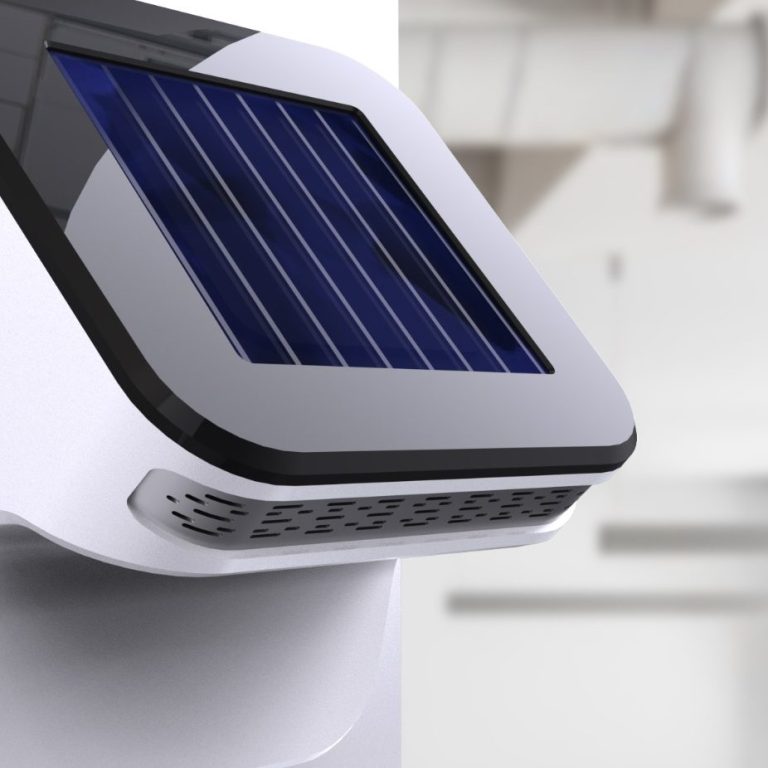
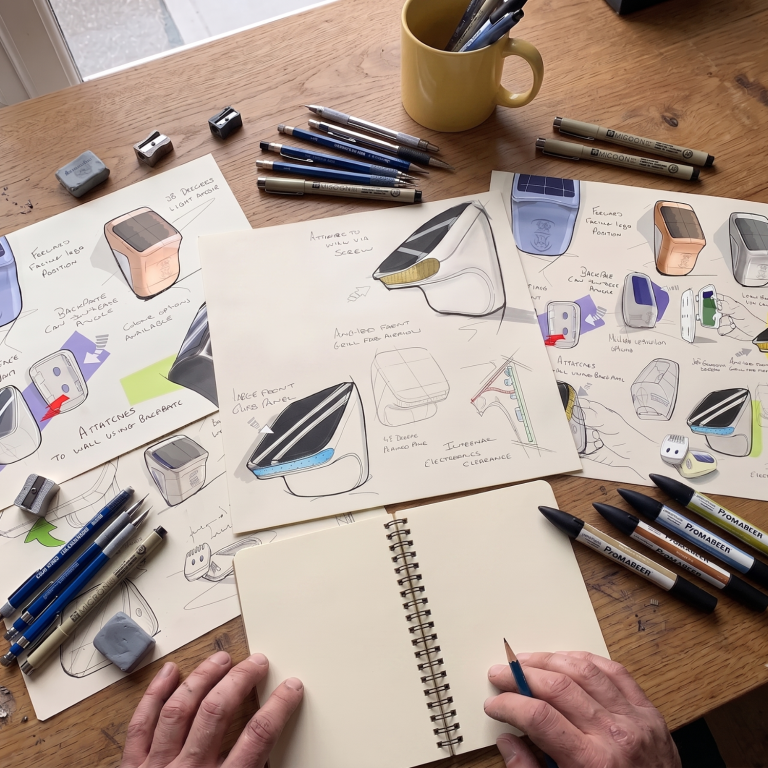
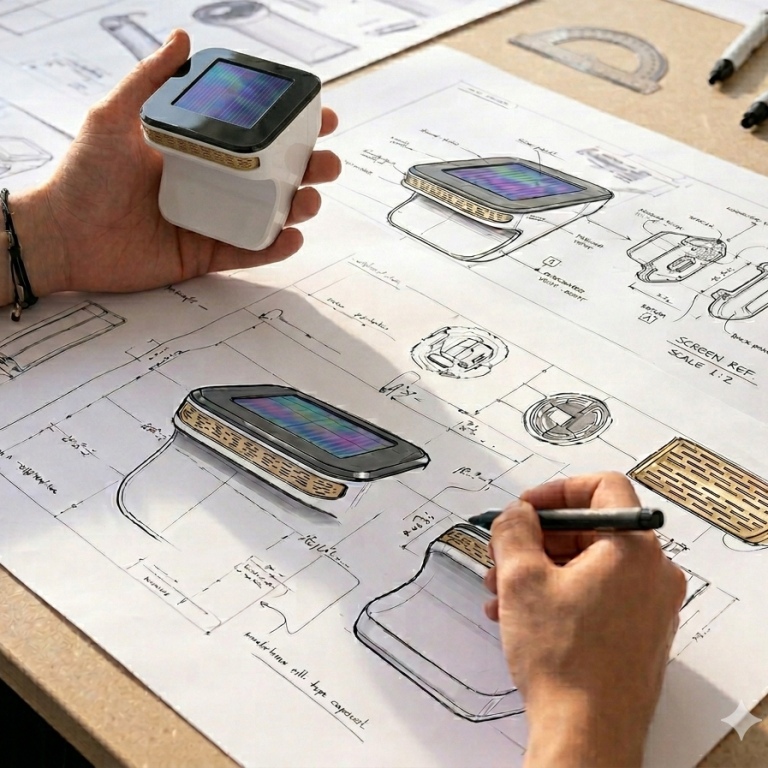
The angled solar panel became the defining feature of the design language — tilted to catch ceiling and ambient lighting when wall-mounted, while the lower body sweeps back to a wall-mount cradle. A perforated speaker/vent grille sits beneath the panel for status alerts and airflow to the internal air quality sensor.
Careful attention was paid to how the device would sit against a wall in real environments — offices, meeting rooms, communal spaces — ensuring the solar face remained optimally angled regardless of mounting height, without the unit reading as an obvious "gadget" in a professional interior.
Detailed Design
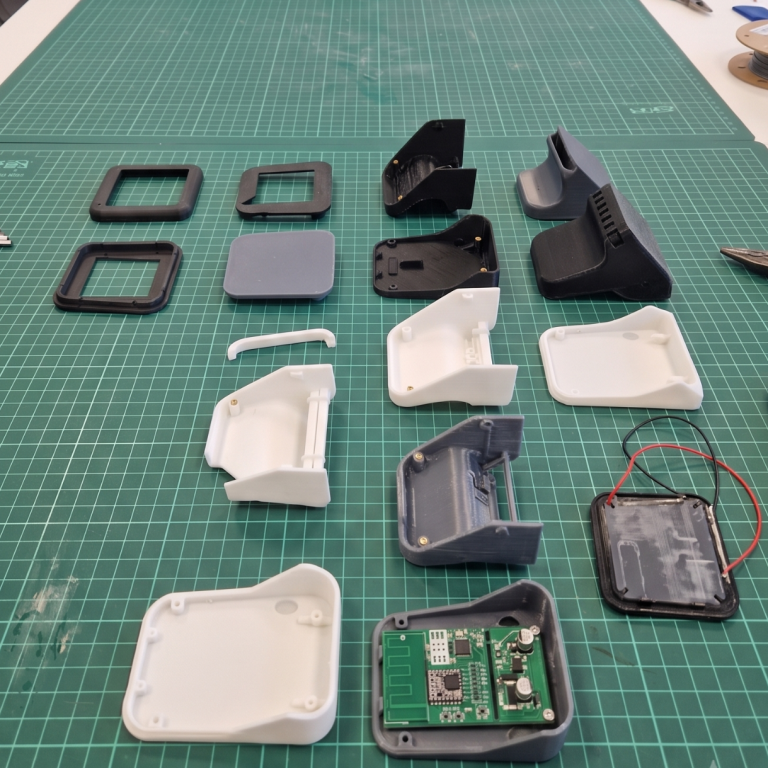
With no external power input, every internal volume mattered. The enclosure went through multiple iterations of the parts breakdown shown here — refining wall thickness, boss placement and the internal shelving that separates the solar/power board from the sensor stack, while keeping the assembly serviceable and the tolerances tight enough for consistent light capture across the panel.
Prototypes were produced by 3D printing to validate fit, fastener placement and the press-fit/screw-boss assembly method before committing to production tooling.
Electronics Integration
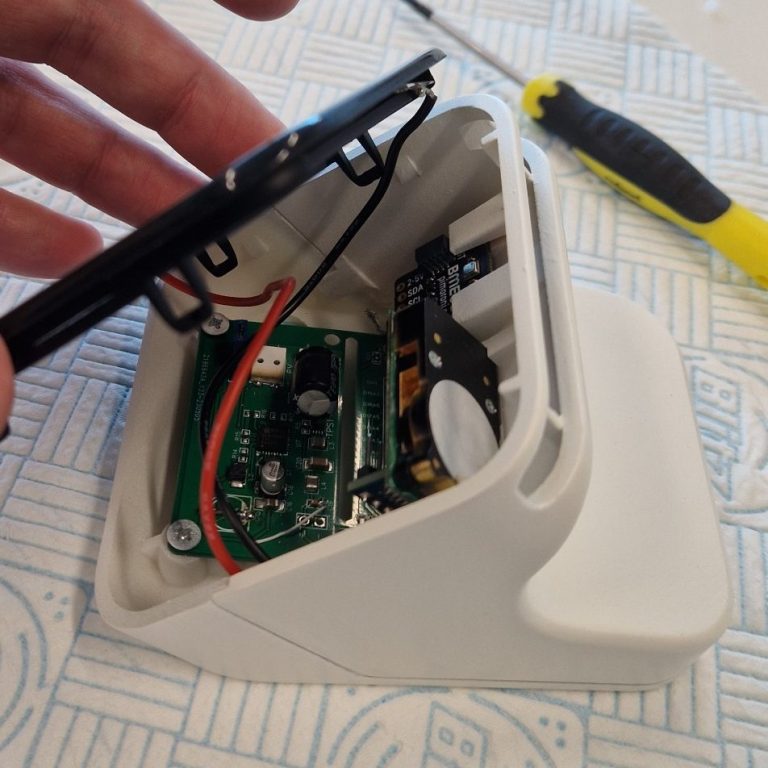
The internal electronics comprise a Pimoroni BME680 environmental sensor for air quality sensing, a dedicated communications module, and a power management PCB regulating charge from the Epishine solar cell. These were arranged across two internal bays to keep signal-sensitive components away from switching noise on the power board, with ribbon and wire routing designed into moulded channels rather than left loose inside the case.
The goal throughout was to preserve the electrical performance of REEF IoT's established sensor and power architecture while packaging it into a footprint dictated by the solar panel geometry — meaning the enclosure had to be designed around the electronics stack, not the reverse.
Production
Component geometry was developed with low-volume manufacturing in mind, keeping side-actions to a minimum and simplifying tooling wherever the solar panel's fixed dimensions allowed. Multiple finish colourways were explored (black and grey variants visible across the prototype sets) to align with different deployment environments, from clinical/lab spaces to standard office interiors.
All work shown on this page was undertaken whilst under contractual engagement with ITERATE UK, REEF IoT, & Swansea University (ATiP Project). All work shown has been created independently or, at the time of release on this portfolio website, had been launched and was within the public domain. The work is shown for personal portfolio presentation purposes only and must not be shared by any third parties. All opinions expressed are by the owner of the website and do not necessarily reflect those of ITERATE UK, REEF IoT, or Swansea University.